
(Repeated from the Summer 2006 issue.)
by JOHN DRAKE ROBINSON
Things are not always as they seem. Trace the outlines of Iron and Reynolds counties on a map and try to decide which one looks more like a B-2 bomber. Then drive through the two-county area and descend into asense of rural peace and simplicity. Rural peace and simplicity, as it turns out, is the literal translation of the greek word “Arcadia.” And Arcadia is the valley at the epicenter of this best-kept Missouri vacation secret.
The area’s pastoral serenity is framed by rugged beauty. But that beauty has come with a heavy price. The land has known upheaval. Three cataclysmic events shattered the tranquility of the area.
The most devastating topographical rearrangement—with the most beautiful result—occurred during the Precambrian period, when stuff you never heard of—like rhyolite and feldspar—thrust through the Earth’s skin. That episode produced the oldest exposed rocks on the North American continent.
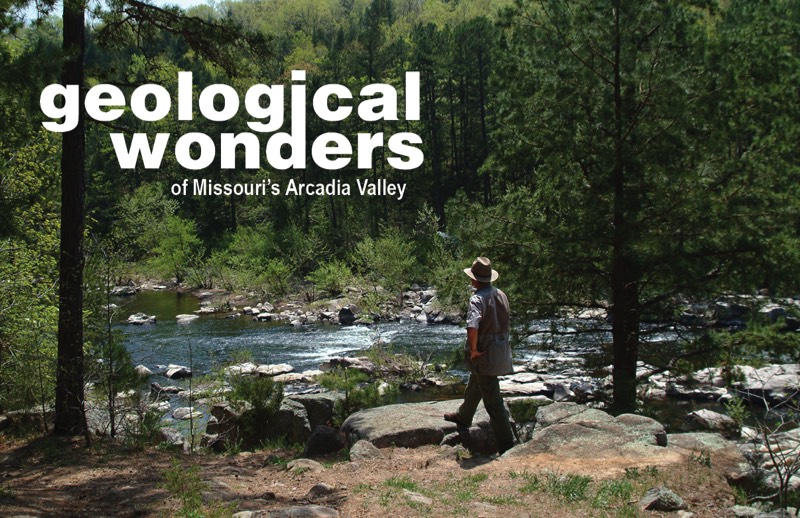
Awesome geologic convulsions produced formations that hint at Mother Nature’s number and timing. At Elephant Rocks, she threw a change-up that delivered the world’s first bat and ball, predating Abner Doubleday by a mere billion and a half years. Up the road, Pickle Springs demonstrates what a little wind and water can do to a crack, given enough time. Eons after the upheaval, Hawn State Park grew a giant patch of pines on its back. It remains unshaven to this day. Nearby, Taum Sauk Mountain waited patiently for the Ozark Trail to find its shoulders and switch back to the summit and down the other side. The Black River smashes into a shut-ins at Millstream Gardens, where boulders resembling igneous chessmen try to stop water. Only aggravated, the water churns a frothy white and beckons brave kayakers to test their skills.
The Precambrian explosion produced a playground with more parks and natural wonders than any other area its size in Missouri. Technically, the Arcadia Valley confines itself to northern Iron and western St. Francois counties. But for the vacationer, greater Arcadia is framed by Washington, St. Francois and Hawn State Parks on the northeast. To the southwest, the Black River and Sam A. Baker State Park offer up watery wilderness.
Back to cataclysm, the area’s second major upheaval occurred during the Civil War. The Battle of Pilot Knob featured a serious of Confederate fusillades on a Union fort, a small earth munitions depot in the valley. Dozens of soldiers died in the daylong battle. Union leaders averted further bloodshed by fashioning a bizarre escape worthy of Houdini. Vastly outnumbered and surrounded by Confederates, the Union soldiers hunkered down to defend their earthen fort until nightfall. They then wrapped their wagon wheels with tents, muffled their horses’ hooves with their coats and slivered between the rebel encampments and off to safety in St. Louis. The Confederates awoke to begin bombardment of…an abandoned fort.
The fort, the museum and the story of the battle—complete with diorama—await in Pilot Knob .
In the third upheaval, the region suffered a calamity of Johnstown Flood proportions. Several decades ago, a utility company built a reservoir atop Profitt Mountain to generate electricity. In the early morning hours of December 16, 2005, water breached the dam, which collapsed, releasing a billion gallons of water that wiped away the campground at Johnson Shut-Ins State Park, along with the park superintendent’s house…with the family inside. They survived. The torrent pushed boulders the size of Volkswagens through the campgrounds; some boulders traveled more than a mile, coming to rest among thick layers of silt, sand, fallen trees and debris. The picturesque Black River, normally a crystal clear mountain stream, turned the color of cocoa. Only the timing of the dam failure—in the dead of winter—averted a terrible cost in human life. Today, Profitt Mountain resembles a miniature Mount St. Helens with a rugged runway gouged from its side. The damage so dramatically altered the area that park officials had no recourse but to rewrite their nature talks and interpret the catastrophe when the park reopened.
by JOHN DRAKE ROBINSON
Things are not always as they seem. Trace the outlines of Iron and Reynolds counties on a map and try to decide which one looks more like a B-2 bomber. Then drive through the two-county area and descend into asense of rural peace and simplicity. Rural peace and simplicity, as it turns out, is the literal translation of the greek word “Arcadia.” And Arcadia is the valley at the epicenter of this best-kept Missouri vacation secret.
The area’s pastoral serenity is framed by rugged beauty. But that beauty has come with a heavy price. The land has known upheaval. Three cataclysmic events shattered the tranquility of the area.
The most devastating topographical rearrangement—with the most beautiful result—occurred during the Precambrian period, when stuff you never heard of—like rhyolite and feldspar—thrust through the Earth’s skin. That episode produced the oldest exposed rocks on the North American continent.
Awesome geologic convulsions produced formations that hint at Mother Nature’s number and timing. At Elephant Rocks, she threw a change-up that delivered the world’s first bat and ball, predating Abner Doubleday by a mere billion and a half years. Up the road, Pickle Springs demonstrates what a little wind and water can do to a crack, given enough time. Eons after the upheaval, Hawn State Park grew a giant patch of pines on its back. It remains unshaven to this day. Nearby, Taum Sauk Mountain waited patiently for the Ozark Trail to find its shoulders and switch back to the summit and down the other side. The Black River smashes into a shut-ins at Millstream Gardens, where boulders resembling igneous chessmen try to stop water. Only aggravated, the water churns a frothy white and beckons brave kayakers to test their skills.
The Precambrian explosion produced a playground with more parks and natural wonders than any other area its size in Missouri. Technically, the Arcadia Valley confines itself to northern Iron and western St. Francois counties. But for the vacationer, greater Arcadia is framed by Washington, St. Francois and Hawn State Parks on the northeast. To the southwest, the Black River and Sam A. Baker State Park offer up watery wilderness.
Back to cataclysm, the area’s second major upheaval occurred during the Civil War. The Battle of Pilot Knob featured a serious of Confederate fusillades on a Union fort, a small earth munitions depot in the valley. Dozens of soldiers died in the daylong battle. Union leaders averted further bloodshed by fashioning a bizarre escape worthy of Houdini. Vastly outnumbered and surrounded by Confederates, the Union soldiers hunkered down to defend their earthen fort until nightfall. They then wrapped their wagon wheels with tents, muffled their horses’ hooves with their coats and slivered between the rebel encampments and off to safety in St. Louis. The Confederates awoke to begin bombardment of…an abandoned fort.
The fort, the museum and the story of the battle—complete with diorama—await in Pilot Knob .
In the third upheaval, the region suffered a calamity of Johnstown Flood proportions. Several decades ago, a utility company built a reservoir atop Profitt Mountain to generate electricity. In the early morning hours of December 16, 2005, water breached the dam, which collapsed, releasing a billion gallons of water that wiped away the campground at Johnson Shut-Ins State Park, along with the park superintendent’s house…with the family inside. They survived. The torrent pushed boulders the size of Volkswagens through the campgrounds; some boulders traveled more than a mile, coming to rest among thick layers of silt, sand, fallen trees and debris. The picturesque Black River, normally a crystal clear mountain stream, turned the color of cocoa. Only the timing of the dam failure—in the dead of winter—averted a terrible cost in human life. Today, Profitt Mountain resembles a miniature Mount St. Helens with a rugged runway gouged from its side. The damage so dramatically altered the area that park officials had no recourse but to rewrite their nature talks and interpret the catastrophe when the park reopened.