
Painting the Town
November 2025
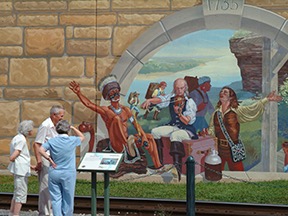
But in the past few years they have popped up like mushrooms. More than 10 dozen Missouri communities have livened up downtown spaces with murals, touting everything from the home of sliced bread to the baby chick capital of the world to the “neatest little town in Missouri.”
The earliest murals still speak to us from caves, where distant ancestors tried their hand at interior decorating. Now, wall art is in full bloom. From Hannibal to St. Joseph and points between, artists have mounted ladders and scaffolds, adorning willing walls with stunning portrayals of local history and culture.
A New York Times reporter visited Cape Girardeau a few years ago. The reporter wasn’t kind, complaining that the drab gray floodwall gave the city a medieval appearance. The wall separated the city from its lifeblood—the river—and discouraged visitors.
Cape Girardeau responded by launching a mural project on that floodwall, a bold artistic feat so stunning that historians will categorize Cape’s history as pre-mural and post-mural. The visuals are that good.
The people of Cape Girardeau embraced their history, their downtown and each other in smacking an artistic grand slam over a 12-foot-tall gray floodwall. And the murals have helped spawn a renaissance throughout downtown Cape Girardeau.
When the city announced a search for the perfect muralist to transform a barren wall, several world-class artists offered their services. Many had impressive credentials. They talked about their muralistic conquests across the globe. They proudly portrayed their portfolios.
Then a visionary young painter named Tom showed up, wearing a cheap suit and a red pork pie hat. Other artists attempted to win Cape’s favor by boasting of their prowess and finesse. Tom took a different approach.
“Who are your characters?” Tom asked. “What is your history?” He courted the town, and the town courted Tom, and they struck a relationship that sank deeper than a coat of paint.
Locals began to recognize him because he always wore that bright red pork pie hat. They spotted him everywhere. Rather than zipping into town for a quick interview and leaving in a whoosh of self-important urgency, Thomas Melvin stuck around. Like a fiddler on the roof, he perched and squatted in every possible spot to perceive the town and its rich fabric.
He talked to the townsfolk, and asked about things that were important to them and to their city. He dined with them at Port Cape Girardeau, a restaurant where, looking out a giant picture window, patrons and New York Times reporters saw an imposing gray floodwall. Tom saw a blank canvas...awaiting.
Now when you sit at a table in front of the big picture window at Port Cape Girardeau with a platter of ribs glazed three times and bathed in smoke, that picture window is bathed in tales of this river community.