
Dent County Museum, Salem
November 2025
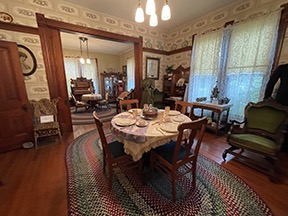
Take a walk through Ozark history at the Dent County Museum in Salem, where three floors of period furniture and artifacts tell the story of the county and its residents. The well-preserved 1895 home boasts beautiful, original pine woodwork and 13 rooms full of interesting displays.
Members of the museum board, which operates the museum, are “interested in preserving the history of Salem and Dent County for future generations,” explains Jo Ann Wells, board president. Most of the board members, all of whom are volunteers, have deep roots in the county and take turns working at the museum when it is open on Sunday afternoons. For example, A.J. Seay, who was on duty the day we visited, says his mother’s family has been in the Sligo/Short Bend area since the 1860s and his father’s family in Salem since the 1870s.
As the sign in the front yard says, the museum began “with a gift from the late Margaret Ray Vickery in 1971.” The museum board bought the home in the early 1970s and converted it into the museum, which opened on May 30, 1976.
Although he was not the original owner of the house, the late William P. Elmer was its most famous resident and was responsible for the addition of the third floor. Elmer, a lawyer, was the first U. S. congressman from Dent County. Many of his descendants still live in the area.
The museum is holding the first William P. Elmer Day on Saturday, October 11. Rick Mansfield, well-known historic interpreter from Ellington, will portray Elmer and share the history of Elmer’s family and home. Homemade cookies and lemonade, plus a performance by the Community Choir, are part of the planned festivities.
The first two floors of the museum are furnished as they would have been in the early 1900s. The third floor features special collections, including a jeweler’s workbench, children’s toys and vintage typewriters. There’s a reproduction—although smaller—of the Liberty Bell, which was cast in honor of the nation’s bicentennial in 1976. There are several outbuildings, including a cellar with a viewing area and an open carriage shed. Tall oak trees shade the yard and the Spring Creek Garden Club maintains the flower beds.
Dent County Museum is located at 400 North Pershing Avenue. The phone number is 573-729-6331. The museum is open from 1-4 p.m. Sundays, from the last Sunday in May through the last Sunday in October, plus special events. Other dates or group tours are available by appointment by calling Jo Ann Wells at 573-729-2643. Admission is free, but donations are accepted. Memberships are available for $10 per person per year or $100 per person lifetime.
Jefferson City Fire Museum, Jefferson City
August 2025
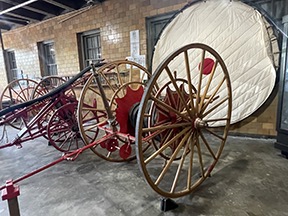
A team of dedicated volunteers can accomplish major goals, as evidenced by the Jefferson City Fire Museum. This fascinating time capsule of mid-Missouri fire-fighting history is the result of countless hours of volunteer labor and leadership, as well as generous donations from personal collections.
Housed in the city’s original Fire Station 2, the museum features vintage pumpers and hose carts, a 1956 fire engine, two authentic poles, vintage equipment and gear and a re-creation of the living quarters of early fire fighters. Displays with signage explain major events in the city’s and the fire department’s history.
“In 2012, the fire department celebrated 100 years of full-time professional fire service for Jefferson City,” says Capt. Steve Holtmeier of the Jefferson City Fire Department. “I was the vice-president of the Centennial celebration and volunteered to be president of the museum, which was the idea of local fire fighters.”
The city owned the limestone building, but it had been structurally modified over the years. The distinctive vertical folding wooden doors with windows had been replaced with roll-up metal doors. Using historical photos for reference, carpenters in nearby Freedom re-created the original style of doors. The goal was to restore the building as it was from 1935 to 1971.
While some volunteers were renovating the building, others were preparing the exhibits. Many of the artifacts were donated by two people. Sherl Frandsen, the city’s first woman firefighter whose father and brother were also firefighters, and Bob Wilbers, retired firefighter, had both been collecting historical memorabilia for years and were instrumental in the development of the museum.
The museum features the garage on the first floor and the living quarters on the second floor. Two authentic fire poles connect the floors. The attached four-story tower was used for high-rise fire-fighting training. The building is a Designated Landmark of the city.
Two key events shaped the city’s fire department history. In 1837, the Missouri State Capitol burned as a result of a flue fire. At the time, the city had a volunteer fire department. In 1911, the Capitol burned, again, this time after the dome was hit by lightning. In response to the 1911 fire, Sedalia and St. Charles tried to have the Capitol moved to their cities. In order to keep the Capitol in Jefferson City, the city established a full-time professional fire department in 1912.
Jefferson City Fire Museum is located at 911 East Miller Street and is open by appointment only. There is no admission fee, but donations are welcome. Call 573-634-6426 or email jeffersoncityfiremuseum@gmail.com. The building can be rented for private events. The upper floor of the museum is not handicap accessible. For more information, visit Jefferson City Fire Museum on Facebook or www.firemuseumjc.com.
Pedalers Bicycle Museum, Springfield
May 2025
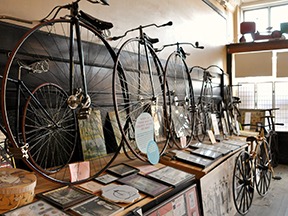
It started out innocently enough for James Allen, owner and curator of Pedalers Bicycle Museum, with the impulse purchase of a 1937 girl’s bike at a swap meet in 1984. From there, the collection has mushroomed into hundreds of bicycles of all shapes and sizes, plus a collection of bicycle-related memorabilia.
The non-profit museum, which opened in 2010, is housed in an 1887 brick building in Springfield’s Commercial Street historic district. Some of the bicycles in the collection are even older than the building, with one of the oldest being an 1817 strider bike, a “walking bicycle” used by surveyors in Germany.
The Missouri Bicycle and Pedestrian Federation has called it “the best and most complete bicycle museum in Missouri, and one of the best in the country and world.”
A popular item with visitors is the 1911 bicycle built by Orville and Wilbur Wright (of Wright Brothers of aviation fame) after they stopped building aircraft. Another is a replica of the 1890s-era bicycles used by Buffalo Soldiers in the 25th Infantry Regiment of the U.S. Army Bicycle Corps for a trip between Missoula, Montana, and St. Louis in 1897. There’s even a 23.5-foot-long custom-built bicycle for 12, and at the opposite extreme, a unicycle with one wheel for one person.
The high-wheel or big-wheel bicycles, popular between 1877 and 1892, are among his favorites. These bikes pair one big wheel with one small wheel. The League of American Bicyclists is a national group that encourages restoring and riding antique bicycles. As a member of the state chapter, Allen has pedaled thousands of miles on a high-wheel bicycle, including a 3,270-mile cross-country journey from San Francisco to Boston in 1991.
Bicycles with equal-sized wheels were introduced in the 1890s and are mostly what we ride today. In the early days, the high-wheel bikes were called “ordinaries” and the equal-sized-wheel bikes were called “safeties,” because they were less dangerous to get on and ride than the high ones.
With some 800 bicycles in his collection and many of them in storage, Allen rotates the exhibits to display different pieces. He can spin off a story for every item in the museum, so a tour can last as long as the visitor has interest.
Among the memorabilia, there are photographs, posters, magazines, books, tools, antique beer steins and even bicycle-themed wine bottles.
Pedal on over to the Pedalers Bicycle Museum for a fascinating tour of two-wheelers through history.
Pedalers Bicycle Museum is located at 328 East Commercial Street and is open 11 a.m.-4 p.m. Tuesday through Thursday or by appointment or chance. Visitors should call 417-576-1464 to arrange group tours. Admission is free, but donations are welcome.
Koshkonong Historical Museum, Koshkonong
February 2025
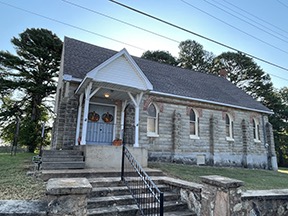
Hope Reed is on a mission to boost her hometown of Koshkonong. As curator of the City of Koshkonong Historical Museum, vice-president of the Oregon County Historical Society and city clerk of Koshkonong, Reed has already succeeded in branding the tiny town as the Gateway to Oregon County.
As a one-woman marketing machine, she is determined to boost attendance at the museum and bring Koshkonong new fame as the closest access to Grand Gulf State Park—if she could just convince the state or the county to pave that 3.2-mile-long gravel road that leads from the railroad track crossing in town to the entrance of the park.
Reed took on the challenge of refreshing the museum and boosting attendance first as a volunteer and now as part of her duties as city clerk. She recently moved her office to the museum, and she hopes to institute regular visiting hours soon. For now, folks can call for an appointment to tour the museum. Her dream is to make the museum the official welcome center for Oregon County, the place people will visit to begin their exploration of Grand Gulf and other county attractions.
At one point in its storied past, Koshkonong boasted a population of 3,000 and was considered as a potential site for the state capital. Today, the population is 212, but don’t be fooled by that small number. There is still plenty of local pride, which is on full display at the annual OCHS Heritage Day in October.
The museum is housed in the 1909 Christian Church building, which later served as a Masonic Lodge until the OCHS bought it in 1994. It now belongs to the City of Koshkonong, as does the nearby 1902 jail house—definitely worth a stop.
The building is packed with items from Kosh (as the locals call it) and Oregon County. One of the most intriguing is the story of the 9-foot 1-inch giant skeleton of a man that was discovered in a nearby cave, along with deteriorating, handmade giant-size furniture. There is a photocopy of a story from the St. Louis Globe-Democrat dated September 9, 1885, about the discovery. Standing beside the life-size cut-out of the giant makes a great photo op.
Other items in the museum include the original telephone switchboard and several antique telephones, a collection of hundreds of ceramic shoes, vintage clothing, the original church bell, school desks and memorabilia, an old-fashioned washing machine and much more. Kosh’s history as a major peach-producing area in the 1890s is documented.
The City of Koshkonong Historical Museum is at the corner of Luyster and School streets. Admission is free but donations are accepted. To schedule a visit, call 417-867-3260. On Facebook, look for The City of Koshkonong Historical Museum.